

As the adoption of electric vehicles (EVs) accelerates, the spotlight is increasingly turning to a pressing challenge: “charging deserts.” These are areas, often rural or underserved, where access to EV charging infrastructure is severely limited or non-existent. While EVs promise a cleaner, greener future, charging deserts present a significant barrier to widespread adoption. Overcoming these gaps is critical for ensuring equitable access to EV charging and unlocking the full potential of electric mobility. Let’s explore the strategies and innovations that can help expand EV infrastructure in underserved areas.
Understanding Charging Deserts
Charging deserts are regions where the lack of EV charging stations makes owning and operating an EV inconvenient or impractical. These areas are often found in:
- Rural Communities: Sparse populations and long distances between towns can make installing charging stations less economically viable for providers.
- Low-Income Urban Areas: In cities, underserved neighborhoods may lack the funding or attention needed to build charging infrastructure.
- Highway Corridors: Some stretches of highway lack sufficient charging stations, creating gaps in long-distance travel routes.
Charging deserts contribute to range anxiety, deter potential EV buyers, and risk leaving entire communities behind in the transition to electric transportation. Addressing this challenge requires innovative thinking, collaboration, and targeted investment.
Strategies to Overcome Charging Deserts
- Leverage Government Incentives and Funding
Governments at the federal, state, and local levels play a pivotal role in closing charging infrastructure gaps. Programs like the U.S. National Electric Vehicle Infrastructure (NEVI) funding allocate resources to expand chargers in underserved areas, particularly along highway corridors. State-specific grants and incentives can further encourage businesses and municipalities to invest in charging stations. - Encourage Utility Involvement
Utilities are uniquely positioned to develop EV infrastructure in charging deserts. They already manage power distribution and can leverage their expertise to install and maintain chargers. Collaborations between utilities, state governments, and private companies can drive infrastructure development while ensuring grid stability. - Public-Private Partnerships
Partnerships between governments and private entities, such as charging network providers, are essential for overcoming funding and logistical challenges. These partnerships can share the financial burden of installation, incentivize investment in rural areas, and create sustainable business models for operating chargers in low-traffic locations. - Focus on Multi-Use Chargers
Installing chargers in locations that serve multiple purposes can increase utilization and make investments more viable. Examples include:- Community centers or libraries in rural areas.
- Shopping centers, where chargers attract customers.
- Gas stations or convenience stores along highways.
- Adopt Scalable and Mobile Solutions
Portable and scalable charging solutions can address immediate needs while laying the groundwork for permanent installations. Mobile chargers, for example, can provide temporary relief in underserved areas, while modular chargers allow for incremental expansion as demand grows. - Integrate Renewable Energy
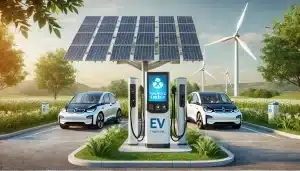
In rural areas where grid access may be limited, solar-powered EV chargers with battery storage offer a sustainable and cost-effective solution. These standalone systems can provide reliable charging without requiring significant upgrades to the local electrical infrastructure. - Incentivize Private Sector Investment
Offering tax credits, subsidies, and other financial incentives can encourage private companies to invest in underserved areas. Programs that offset installation costs or provide long-term operational support can help mitigate the risks associated with deploying chargers in low-demand regions. - Create Community Charging Hubs
Centralized charging hubs can serve entire communities, making EV ownership more feasible in charging deserts. These hubs might include multiple charging stations, renewable energy integration, and amenities for drivers to use while charging. - Raise Awareness and Education
Expanding EV infrastructure in underserved areas isn’t just about hardware—it’s also about mindset. Community outreach programs can educate residents about the benefits of EVs and how to access available resources, creating demand and increasing charger utilization. - Mandate Equitable Development
Policymakers can require that charging infrastructure investments prioritize underserved areas. Equity-focused regulations can ensure that rural and low-income communities receive their fair share of EV infrastructure, closing gaps that might otherwise be overlooked.
Innovations Driving Change
Emerging technologies are also playing a key role in overcoming charging deserts. Ultra-fast chargers, capable of delivering significant range in minutes, are being deployed along highways to reduce range anxiety. Additionally, advancements in vehicle-to-grid (V2G) technology allow EVs to act as mobile power sources, potentially providing energy to areas without adequate infrastructure.
Electric co-ops and local initiatives are also stepping in. For example, community-led charging networks in rural areas are demonstrating how small-scale, locally managed solutions can make a big impact.
The Path Forward
Addressing charging deserts is about more than just convenience—it’s about ensuring a fair and inclusive transition to electric mobility. Without equitable access to charging infrastructure, entire communities risk being left behind in the shift toward sustainability.
By combining government initiatives, utility support, private investment, and community engagement, we can bridge the gap and bring EV charging to all corners of the map. With these strategies, underserved areas can become part of the electric future, ensuring everyone has the opportunity to benefit from cleaner, more affordable transportation. The road ahead is electric, and with the right efforts, it can be a road everyone can travel.